


Apr 22 In-Class Exercise Thread .
Post your solutions to the Apr 22 In-Class Exercise to this thread.
Best,
Chris
- Let the NTM M = {Q, S, T, delta, q_0, F}, where
Q = {q_0, q_1}, S = {a,b}, T = {a,b,_}, F = {q_1}, and delta = {δ(q_0,a)={(q_0,a,L),(q_0,a,R)}, δ(q_0,b)={(q_0,a,L),(q_1,b,L)}.
- Let NTM read the string "b".
Then, M makes the following transition, which is in the transition function: (q_0, b) (q_1, b, L).
And, q_1 is an accept state in F, so we're done.
(Edited: 2020-04-22)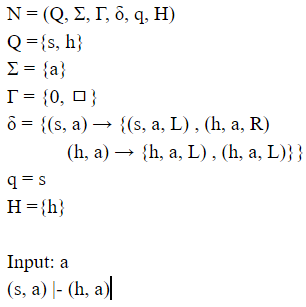
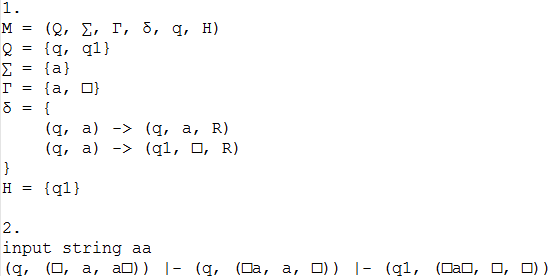
(Q,Σ,Γ,δ,1,H)
where Q={1, 2}
Σ = {a}
Γ = {a, }
δ = { (1, a) -> (1, a, R)
(1, a) -> (2, □, R)}
H = {2}
for input aa
(1, |a|a) |- (1,a|a|) |- (2, a)
where for wx|y|z, symbol y is being read in wxyz
N = ({q,q}, {a}, {a,_}, δ, q, {q})
δ = {(q,a) -> (q,a,R)
(q,a) -> (q,,R)}
Input: aaa
(q, [a]aa) |- (q, a[a]a) |- (q, aa[a]) |- (q`, aa)
M = {Q, Σ, Γ, δ, q, H} Q = {0, 1} Σ = {x} Γ = {x, } δ = {(0, x) -> (0, x, R) (0, x) -> (1, , R)} H = {1}
input xx (0, (, x, x) |- (x, x, )) |- (1, (x, , ))


