
2018-05-14

May 14 Final Review .

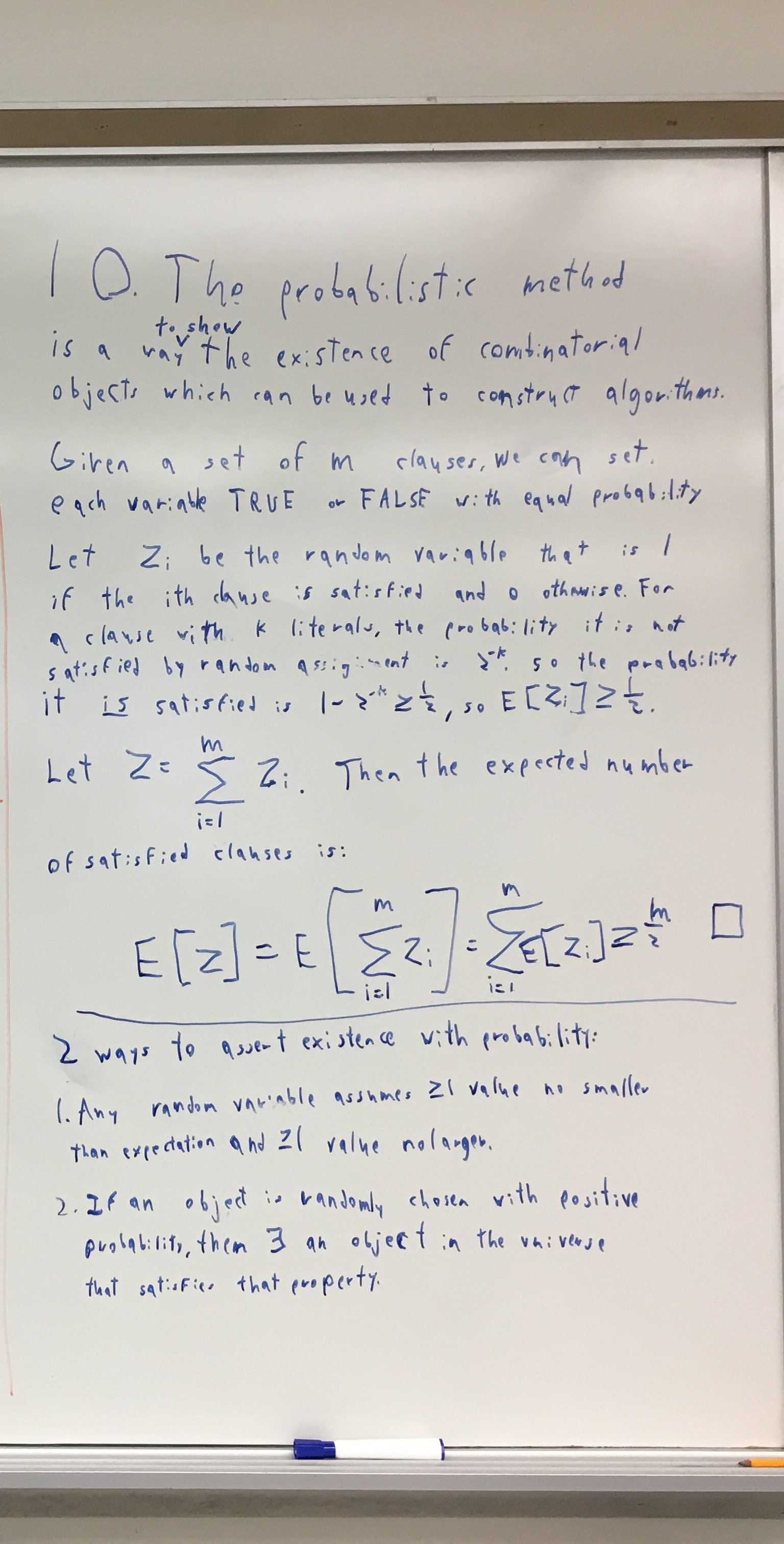
<nowiki> Solution for Q1. Posted by Heemany Shekhar, Nag Mani, Revanth Akella

Resource Description for 20180514_135431.jpg

</nowiki>

<nowiki> Solution for Q1. Posted by Heemany Shekhar, Nag Mani, Revanth Akella ((resource:20180514_135431.jpg|Resource Description for 20180514_135431.jpg)) </nowiki>

-- May 14 Final Review

Posted by Dean Johnson, Sharan Duggirala, Saketh Saxena

Q3: a mod 42, a mod 2 = 0, a mod 3 = 2, a mod 7 = 5

m1 = 42 / 2 = 21 m2 = 42 / 3 = 14 m3 = 42 / 7 = 6

t1 = 21^-1 mod 2 = 1 t2 = 14^-1 mod 3 = 2 t3 = 6^-1 mod 7 = 6

c1 = 21 * 1 = 21 c2 = 14 * 2 = 28 c3 = 6 * 6 = 36

a = (021) + (228) + (5*36) = 56 + 180 = 26 mod 42 = 26

Posted by Dean Johnson, Sharan Duggirala, Saketh Saxena Q3: a mod 42, a mod 2 = 0, a mod 3 = 2, a mod 7 = 5 m1 = 42 / 2 = 21 m2 = 42 / 3 = 14 m3 = 42 / 7 = 6 t1 = 21^-1 mod 2 = 1 t2 = 14^-1 mod 3 = 2 t3 = 6^-1 mod 7 = 6 c1 = 21 * 1 = 21 c2 = 14 * 2 = 28 c3 = 6 * 6 = 36 a = (0*21) + (2*28) + (5*36) = 56 + 180 = 26 mod 42 = 26

-- May 14 Final Review

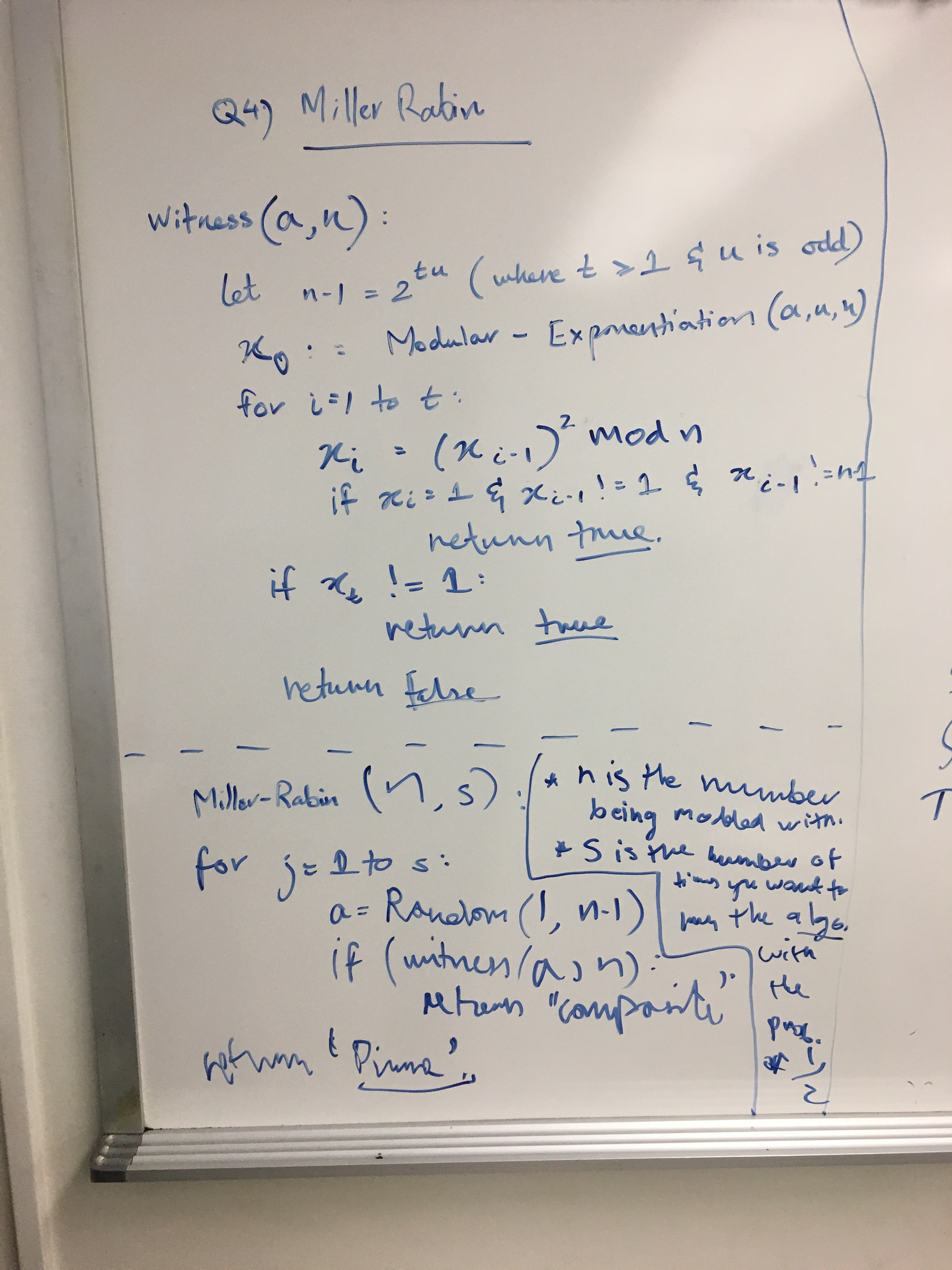
&lt;nowiki&gt;((Solution by Dean Johnson, Sharan Duggirala and Saketh Saxena))
Resource Description for image_123923953.JPG

&lt;/nowiki&gt;

(Edited: 2018-05-14)
<nowiki>((Solution by Dean Johnson, Sharan Duggirala and Saketh Saxena)) ((resource:image_123923953.JPG|Resource Description for image_123923953.JPG)) </nowiki>

-- May 14 Final Review

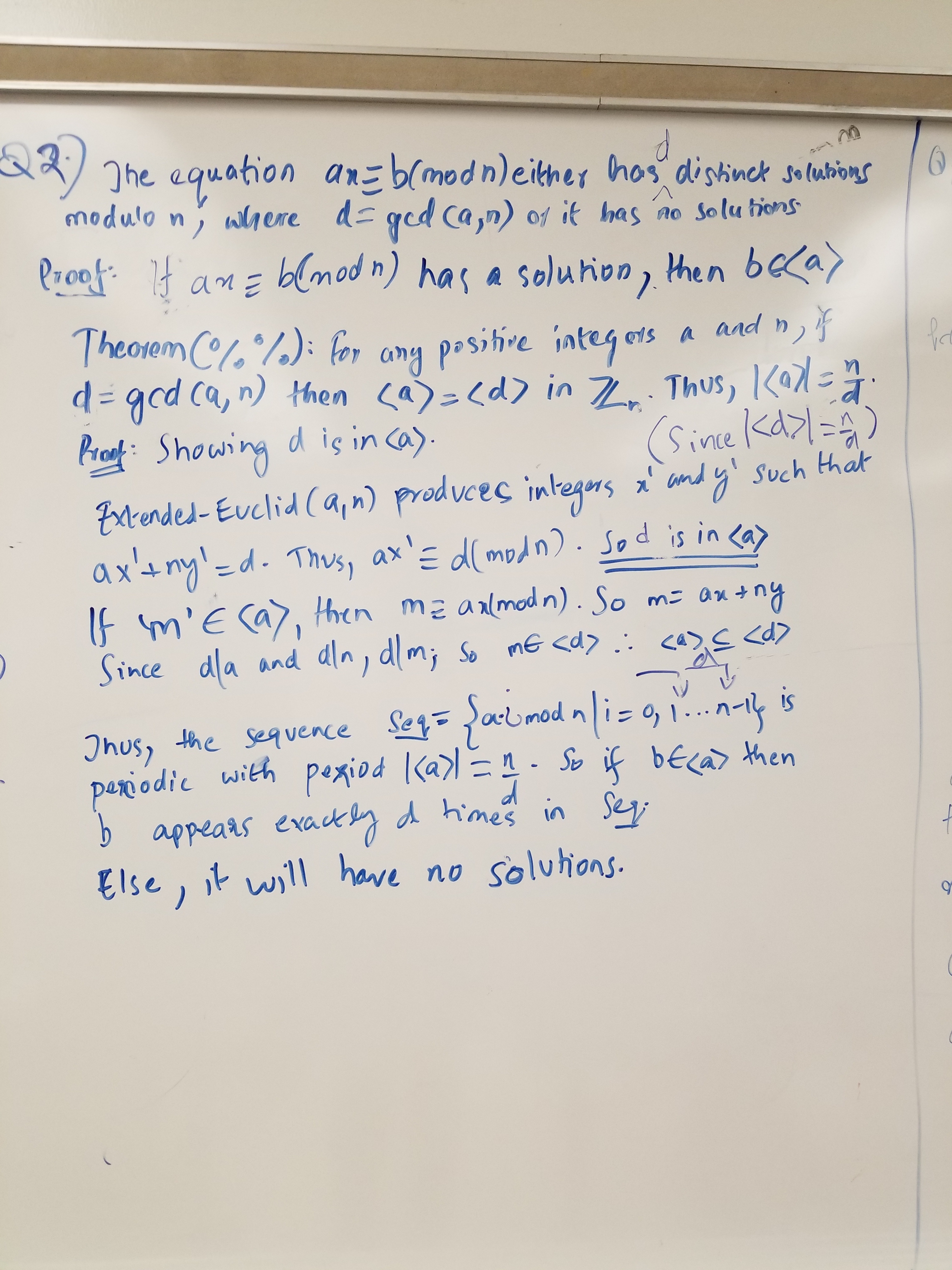
&lt;nowiki&gt; Solution for Q2.

Posted by Heemany Shekhar, Nag Mani, Revanth Akella
Resource Description for 20180514_142436.jpg

&lt;/nowiki&gt;

<nowiki> Solution for Q2. Posted by Heemany Shekhar, Nag Mani, Revanth Akella ((resource:20180514_142436.jpg|Resource Description for 20180514_142436.jpg)) </nowiki>

-- May 14 Final Review

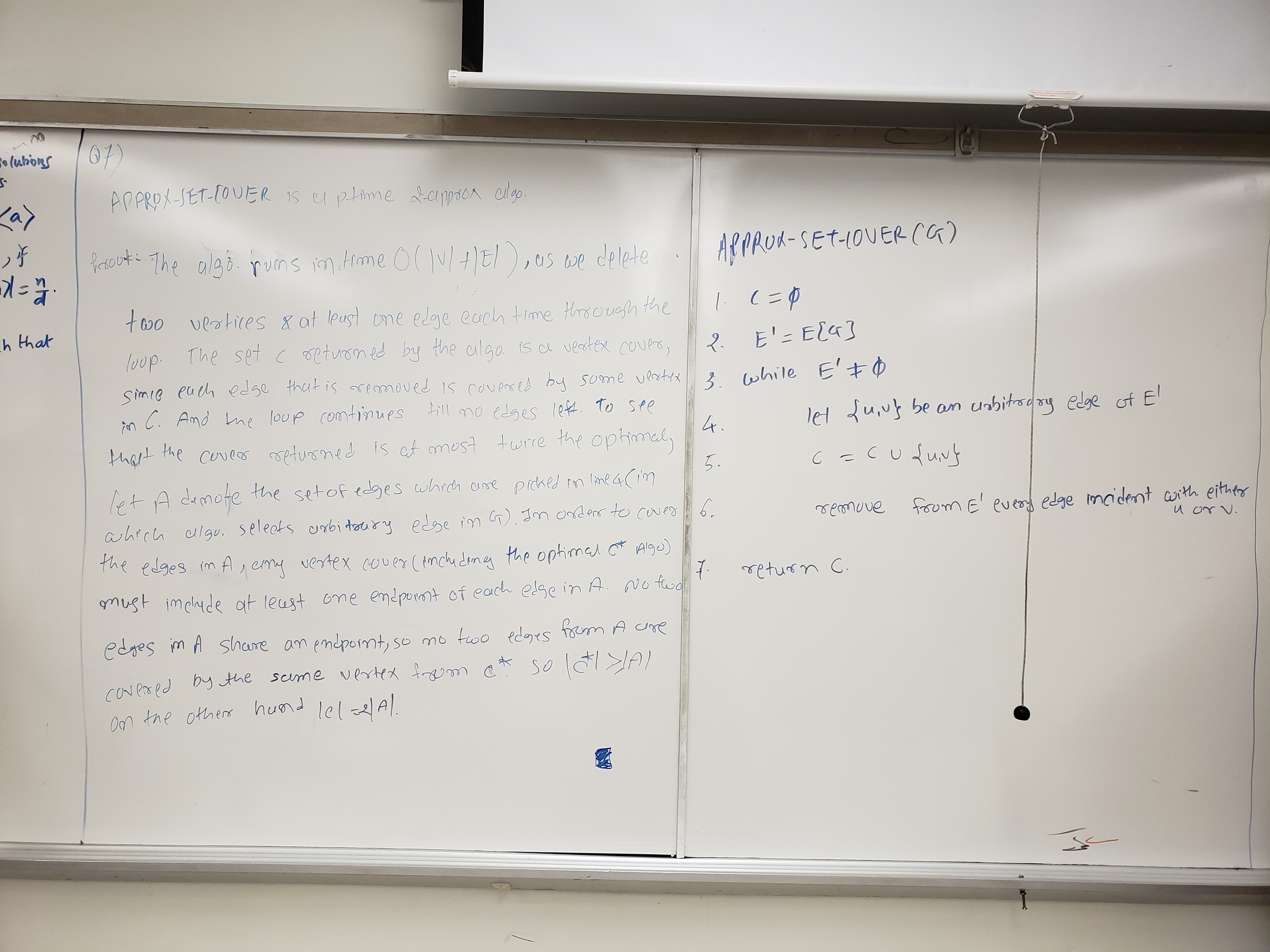
Team: Pratik, Niket, kunal

APPROX-VERTEX-COVER (I wrote APPROX-SET-COVER on board, please igore that ) Resource Description for 20180514_140958.jpg
(Edited: 2018-05-22)
Team: Pratik, Niket, kunal APPROX-VERTEX-COVER (I wrote APPROX-SET-COVER on board, please igore that ) ((resource:20180514_140958.jpg|Resource Description for 20180514_140958.jpg))

-- May 14 Final Review

Kunal, Niket, Pratik &lt;nowiki&gt;

&lt;/nowiki&gt;

Q8 ) &lt;nowiki&gt;

&lt;/nowiki&gt;

Resource Description for Screenshot from 2018-05-14 15-00-19.png

(Edited: 2018-05-20)
Kunal, Niket, Pratik <nowiki> </nowiki> Q8 ) <nowiki> </nowiki> ((resource:Screenshot from 2018-05-14 15-00-19.png|Resource Description for Screenshot from 2018-05-14 15-00-19.png))

-- May 14 Final Review

Vincent, Nick, Ravali

Problem 9 : Resource Description for IMG_2746.JPG

(Edited: 2018-05-14)
Vincent, Nick, Ravali Problem 9 : ((resource:IMG_2746.JPG|Resource Description for IMG_2746.JPG))

-- May 14 Final Review

Nick, Vincent, Ravali

Problem 10 : Resource Description for IMG_2744.jpg

(Edited: 2018-05-14)
Nick, Vincent, Ravali Problem 10 : ((resource:IMG_2744.jpg|Resource Description for IMG_2744.jpg))
2018-05-15

-- May 14 Final Review

Siddharth, Shantanu, Shashank

Ans.5) Define NP, NP-complete, and NP-hard. Argue the problem of determining where every assignment to a 3-SAT instance is satisfying is NP-hard.


NP: A Language L belongs to NP if there exists a two input polynomial-time algorithm A and a constant c such that

L = { x &isin; {0,1}* : &exist;y, |y| = O(|x|^{c}) and A(x,y)=1 }

NP-Complete: A Language L is NP-Complete if

  1. L &isin; NP, and
  2. L&#039; &le; L in polynomial time, for every L&#039; &isin; NP

NP-Hard : A language which satisfies (2) but not necessarily (1) is called NP-Hard. We can say that NP-Complete is a subset of NP-Hard.


We are trying to solve the second part of this question, if anyone feels they have a solution, do upload.

(Edited: 2018-05-15)
Siddharth, Shantanu, Shashank Ans.5) Define NP, NP-complete, and NP-hard. Argue the problem of determining where every assignment to a 3-SAT instance is satisfying is NP-hard. ---- NP: A Language L belongs to NP if there exists a two input polynomial-time algorithm A and a constant c such that L = { x ∈ {0,1}* : ∃y, |y| = O(|x|^{c}) and A(x,y)=1 } NP-Complete: A Language L is NP-Complete if 1) L ∈ NP, and 2) L' ≤ L in polynomial time, for every L' ∈ NP NP-Hard : A language which satisfies (2) but not necessarily (1) is called NP-Hard. We can say that NP-Complete is a subset of NP-Hard. ---- We are trying to solve the second part of this question, if anyone feels they have a solution, do upload.

-- May 14 Final Review

Siddharth, Shantanu, Shashank

Ans 6. p-time reduction from 3-SAT to CLIQUE Let F=C_1 &and; C2... &and; C_k be an instance of 3SAT. For each C_r=(l^r_1&or;l^r_2&or;l^r_3), we put a triple of vertices into our graph G, v^r_1,v^r_2,v^r_3. We put an edge between vertices v^r_i and v^s_j if they are in different triples and their corresponding literals are not negations of each other. Let (G,k) be the output instance of CLIQUE. Notice if there is a satisfying assignment to F then if we look at the corresponding vertices v^r_j of at least one satisfied literal/clause, it will be a CLIQUE of size k in G. As there are no edges between vertices coming from the same clause, any CLIQUE of size k has to have at least one vertex v^r_j for each 1&le;r&le;k. Choosing an assignment so that the corresponding literals for each v^r_j evaluate to true gives a satisfying assignment. So the reduction works.

Siddharth, Shantanu, Shashank Ans 6. p-time reduction from 3-SAT to CLIQUE Let F=C_1 ∧ C2... ∧ C_k be an instance of 3SAT. For each C_r=(l^r_1∨l^r_2∨l^r_3), we put a triple of vertices into our graph G, v^r_1,v^r_2,v^r_3. We put an edge between vertices v^r_i and v^s_j if they are in different triples and their corresponding literals are not negations of each other. Let (G,k) be the output instance of CLIQUE. Notice if there is a satisfying assignment to F then if we look at the corresponding vertices v^r_j of at least one satisfied literal/clause, it will be a CLIQUE of size k in G. As there are no edges between vertices coming from the same clause, any CLIQUE of size k has to have at least one vertex v^r_j for each 1≤r≤k. Choosing an assignment so that the corresponding literals for each v^r_j evaluate to true gives a satisfying assignment. So the reduction works.
X