

Practice Midterm Solution Thread .
Please post your solutions to your practice midterm problems to this thread.
Best,
Chris
Question 3 Partner: Chris Mccain
Every identifier is declared before it is used
No identifier is used in an inappropriate context
Subroutine calls provide the correct number and types of arguments
Any function with a non-valid return type returns a value explicitly
(Edited: 2021-10-11)<pre> Question 7 Nicholas Semaan, Yuanye Yang, Ameya Dighe
There is 3 possibilities for 2 operators S + id | S - id | S * id Only id can also come. So, together it is given below Grammar S -> S|S + id S -> S|S - id S-> S|S * id S -> id </pre>
(Edited: 2021-10-11)<pre> Question 1 Andre Domingo, Mark Masulis a. Functional programming languages are based on lambda calculus. Functional programs use trees of expressions. Lisp is a functional programming language.
b. A dataflow programming language uses functional nodes that activate upon receiving data. They can act in parallel. Verilog is a dataflow programming language.
c. Logic-based programming languages define rules which the program follows. Programs run queries on these rules and receive an output. Prolog is a logic-based programming language.
d. A von Neumann language alters program execution by changing values in memory. They are the most common programming languages. C is a von Neumann programming language. </pre>
(Edited: 2021-10-11)Jason Hammar Leo Alciso Edward Phan Question 2: Short answer: (a) If your C program consists of only one file, why may a linker still be used? (b) How is the loader for a compiled C program typically invoked (either *nix or Windows)? (c) What is a self-hosting compiler? (d) How does compiler bootstrapping work for self-hosting compilers?
Answer to (a): It is important to have a linker in a C program with one file because there may still be some object files you may need to link in an executable. An example would printf(); It can only be used with stdio.h.
Answer to (b): After the executable is made use ./ to load the program into ram and execute the main.
Answer to (c): A self-hosting compiler is a compiler that can compile its own source code.
Answer to (d): Bootstrap compiler is used to compile the compiler and then you can use this compiled compiler to compile everything else as well as future versions of itself.
(Edited: 2021-10-11)Christina Ng, Bill Li, Harrison Hwang
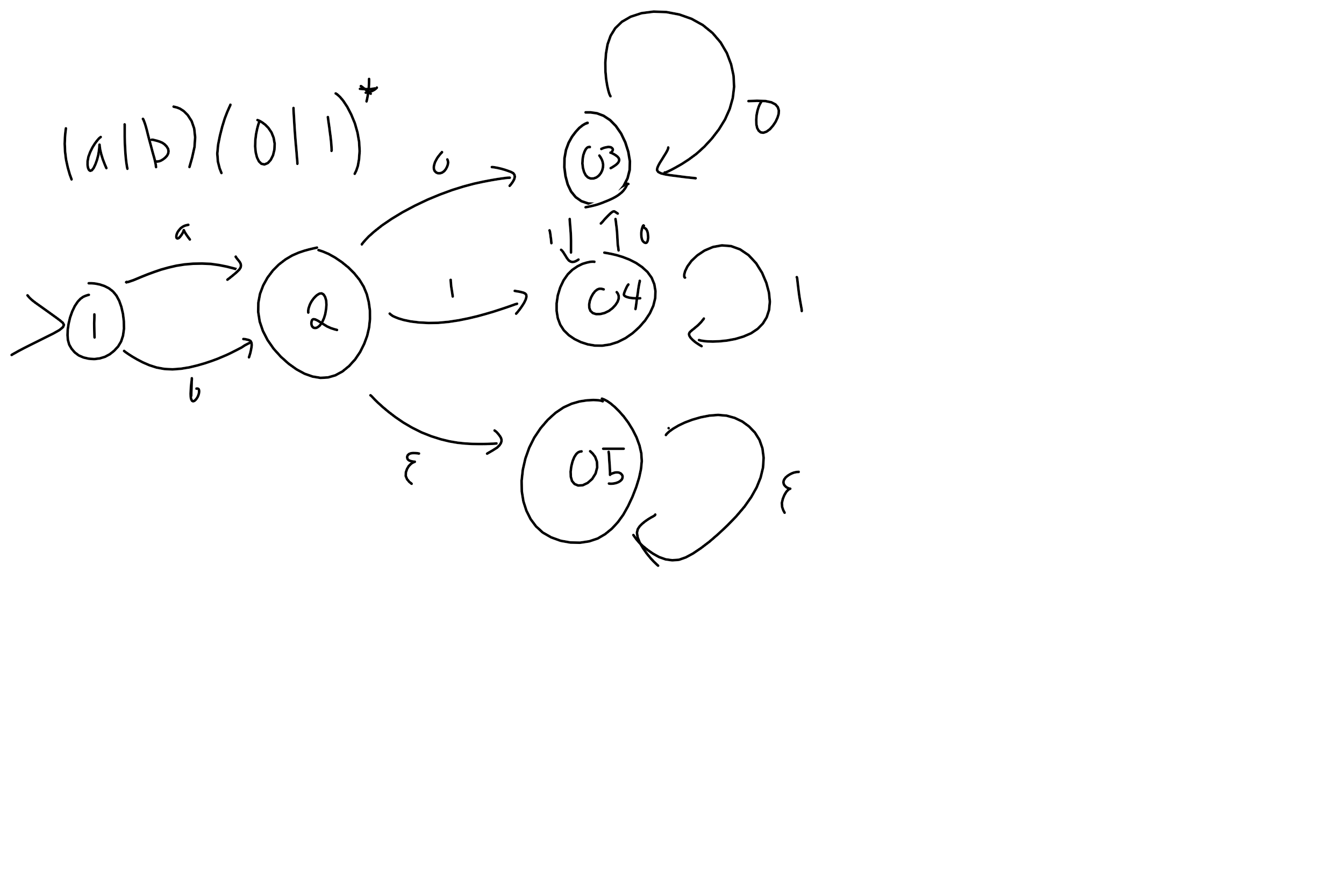
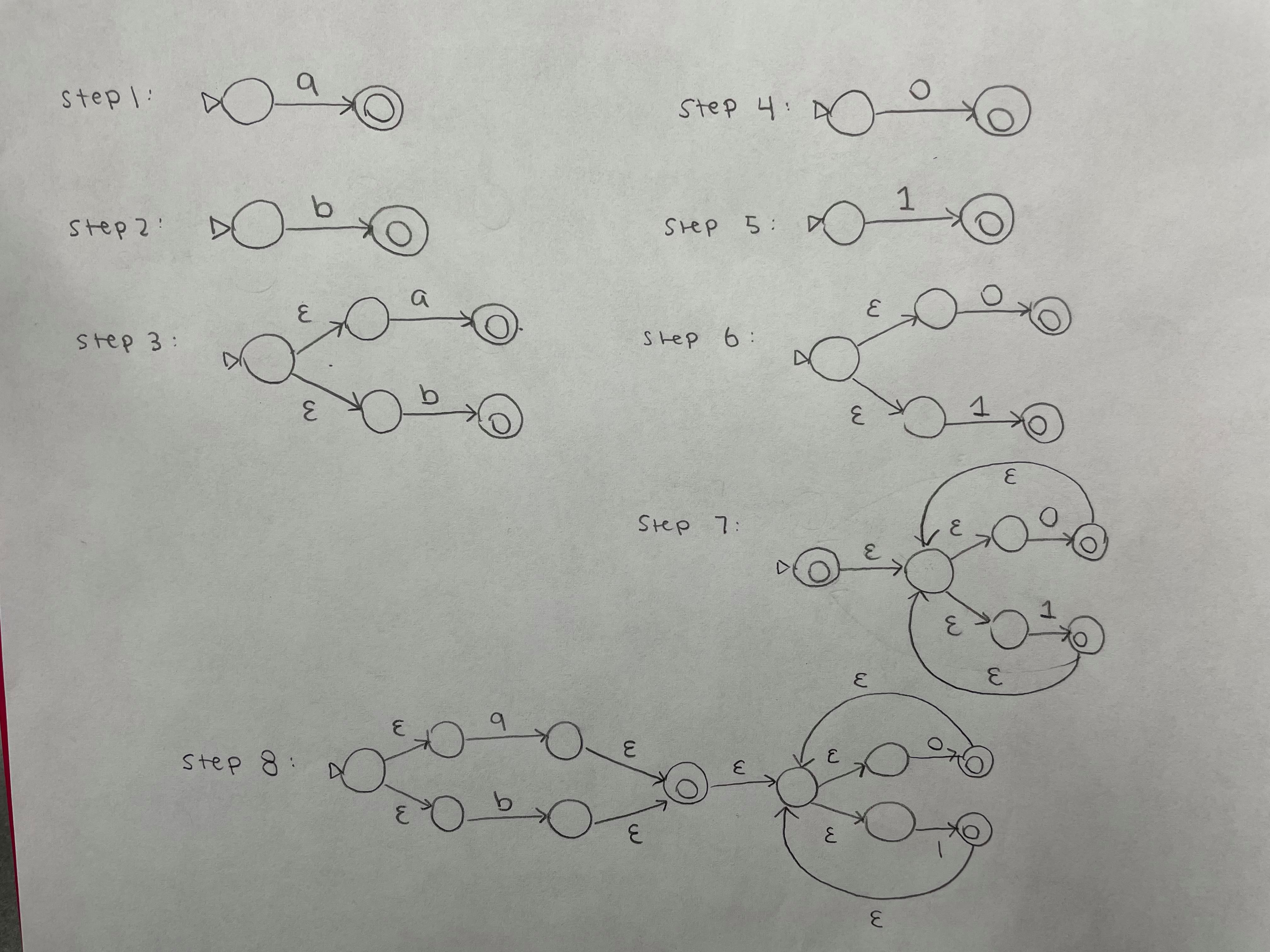
- Show step-by-step how our procedure from class would convert the regular express (a|b)(0|1)* to an NFA.
Q4: Connor Pietrasik, Thanh Le, Brandon Ong <pre> #include <stdio.h> #include <math.h>
typedef struct Polar{ float angle; float r; } Polar;
int main(void){ FILE* fp = fopen("foo.txt", "r");
//Figured having a max amount is fine since it's a test and we'll be rushing
Polar coords[20];

int count = 0;
float x, y;
for (; fscanf(fp, "%f,%f", &x, &y) > 0; count++){
    coords[count].r = sqrt(x * x + y * y);
    coords[count].angle = atan(y / x);
}

for (int i = 0; i < count; i++){
    printf("%.2f\n", coords[i].angle);
}

return 0;
} </pre>
(Edited: 2021-10-11)Ian Chavez Jesse Dong
Question 9: Define the following concepts related to stack and heap based allocation:
Frame Pointer - Value pointing to the base address of the called functions instance frame. Used because stack frame location cannot be predicted at compile time.
Calling Sequence - The set of instructions to set up and call a subroutine, as well as get the required data for the subroutine, as well as tell the computer where to return after the subroutine is executed.
Buddy System Heaps - Method of splitting memory based on best fit, if 2^k is too small, find a 2^k+1 size block, divide by 2 and check if it fits. If it fits, put spare half to the free list. Once used half is deallocated, combine with the spare half.
Garbage Collection - Process that runs on a continuous thread that periodically wakes up to check for memory that do not have a reference pointer.
(Edited: 2021-10-11)<nowiki>Question 5: Daniel Pu and Andy Luong
Makefile is a build utility that defines a set of tasks to be executed on certain files. They are also a simple way to organize code compilation as you can simply type make task name in the console within the correct directory, which will execute the commands corresponding to the task for you.
Variables are names in the Makefile that represent a string(s) of text, which is
also known as the variables value. These variables along with their values can be
substituted within the rest of the Makefile as requests to targets, dependencies,
or commands. To use variables in make files, type a dollar sign with parentheses
or braces and in it is the variable name like (objects). For notations, @ refers
to the name of the target that is being generated, < refers to the first
prerequisite of the target, and ^ refers to all prerequisites for the target.
An example program with more than one target and with a clean target in C can be the following:
objects = program.o foo.o utils.o
program : (objects)
cc -o program (objects)
$(objects) : defs.h
all: output main.o message.o
output: main.o message.o gcc main.o message.o -o output
main.o: main.c gcc -c main.c
message.o: message.c message.h gcc -c message.c clean: rm -rf output </nowiki>
(Edited: 2021-10-11)Sweet Zhang,
Kyle Domen,
Tomer Erlich
Question 6: